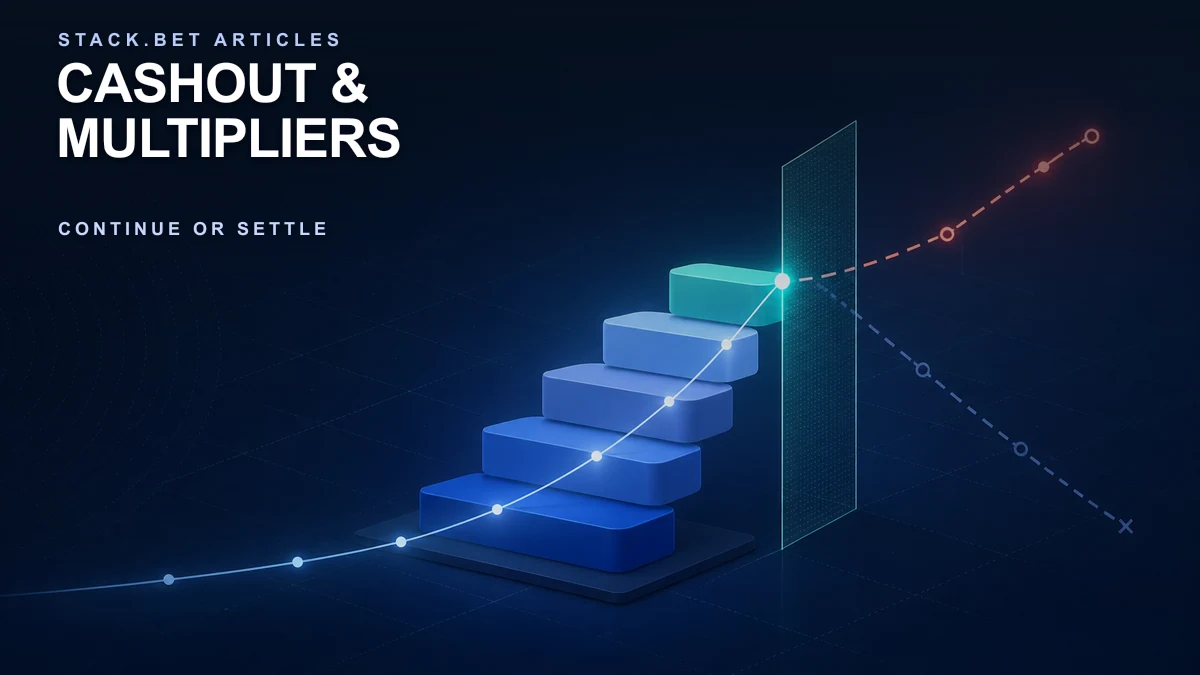
A Stack.bet multiplier grows after each survived tile. In-game cashout ends the active round at its current authoritative amount and sends that result for settlement. Continuing instead leaves the current potential amount exposed to the next tile’s bust risk.
In-game cashout is not a wallet withdrawal
In Stack.bet, cashout is a game action. It ends an active round and settles the round’s current native-asset amount to the player’s game balance. A withdrawal is a separate account transaction that moves an available balance through the supported withdrawal process.
Cashing out a round therefore does not mean that funds have already been sent to an external wallet. It records a terminal game result first. Withdrawal availability, verification, network processing, and account controls belong to the separate withdrawal flow.
How the cumulative multiplier grows
Every configured tile has a growth factor. When a placement survives, the engine multiplies the previous round multiplier by that tile’s growth factor and rounds the internal multiplier to eight decimal places. It also enforces the configured maximum multiplier.
New cumulative multiplier = previous multiplier × current tile growth factor
Applied multiplier = the lower of that result and the configured maximum
The public table shows cumulative values after the named level. Under the configuration reviewed for this article, level 1 is 1.05×, level 10 is displayed as 2.3×, level 20 as 112.38×, and level 30 as 1,171,935.85×. Those values are current configuration facts, not a statement that a player is likely to reach the later levels.
How the potential cashout amount is calculated
After a survived placement, the game service calculates the current round amount from the original stake and the new cumulative multiplier. The amount shown as potential cashout includes the original stake; it should not be described as profit.
Potential cashout amount = original stake × current cumulative multiplier
Potential net change = potential cashout amount − original stake
For example, a 10-unit stake at a 1.05× multiplier has a potential cashout amount of 10.5 units. The potential net change is 0.5 units, not 10.5. This example uses generic units because supported assets have their own display and settlement precision.
When in-game cashout is available
The standard public configuration currently marks cashout as available. The active-round service still requires at least one accepted, survived tile before it will accept a player cashout. Cashout is not available before the first successful placement or after the round has already reached a terminal result.
A valid request must also identify the active authoritative round and come from the controlling player session. The service can reject a stale, duplicate, unauthorized, or otherwise conflicting request instead of applying it to a different round.
“Cash out anytime” is therefore too broad. The precise description is that a player can request in-game cashout after at least one survived tile while the current rules permit it and the round remains active.
What authoritative settlement means
When a valid cashout request is accepted, the game service finishes the round with its current multiplier and amount, persists the terminal cashout and finished events, and sends the result through the authoritative settlement workflow. The player-facing event reflects the persisted round result rather than a new amount calculated only in the browser.
Settlement is designed to be repeat-safe, so retrying the same valid action does not create a second round payout. A temporary settlement delay is also different from a bust: the terminal result can already be recorded while the service completes authoritative confirmation.
If a result appears delayed or inconsistent, keep the round ID and contact Stack.bet support. Do not start a second action to guess around an unresolved status.
What remains at risk when you continue
A current multiplier is not locked merely because it is visible. Choosing to place the next tile keeps the round open. If that placement busts, the engine sets the round multiplier and amount after the attempt to zero. The potential amount from the previous tile was never cashed out and is not paid separately.
Surviving the next tile increases the cumulative multiplier, but the next base bust chance also follows the current risk table and placement pressure may apply. Read how placement grades affect bust risk before treating the multiplier as the only relevant number.
Under the current 30-tile configuration, surviving the final tile automatically finishes the round as a win at the authoritative final amount. The final multiplier is a configured ceiling, not a guaranteed or typical outcome.
What cashout and multipliers do not promise
A large visible multiplier does not make the next tile safe.
A potential cashout amount is not settled until the terminal action is accepted.
In-game cashout is not an external-wallet withdrawal.
The total cashout amount includes the stake and should not be labelled entirely as profit.
No cashout point guarantees a profitable session or prevents gambling loss.
Decide your stake and stopping point before a round rather than chasing an earlier loss. Stack.bet provides responsible-gaming and account controls, and its game disclosures explain the real-money risks.
Methodology and change control
This article was reviewed on against the live public game configuration, the multiplier and amount calculations in the game engine, and the active-round cashout and settlement workflow. Public multiplier examples use the rounded values displayed by the current risk table.
Cashout availability, maximum tile, growth factors, multipliers, settlement behavior, and supported assets can change. A material rule or workflow change requires a factual review, updated examples, and a new last-reviewed date before republication.